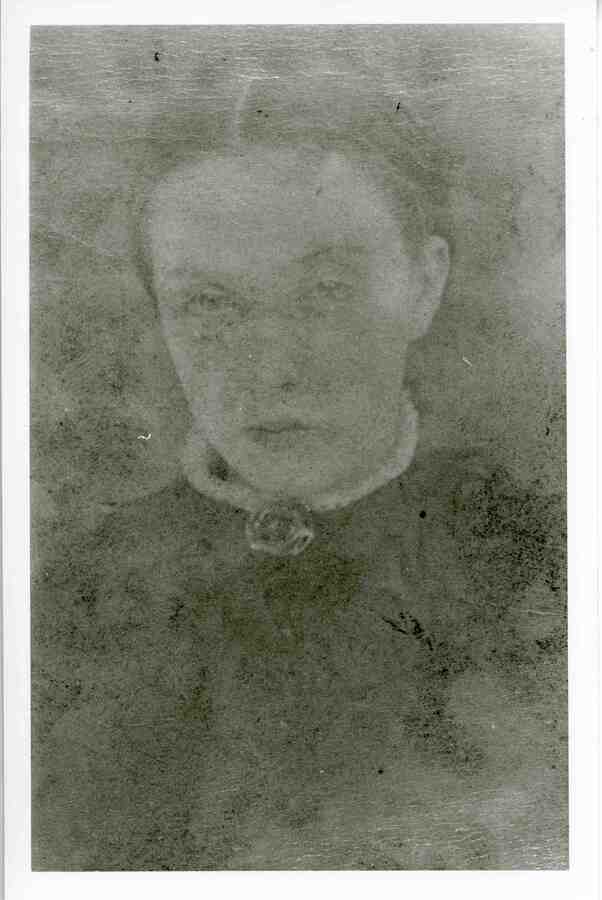
Four photographs of Barbara Watson are fastened to the end of a seven-page account of the young woman’s case. The entry is contained in a journal written by a pioneering surgeon called William Macewen. In one of the photographs, she is wearing a brooch, in the shape of a rose. It is pinned at the centre of her neckline, to a starched dark collar fringed with lace. Her mouth forms a similar rose shape, small and round as if surprised, or on the verge of speaking, while her heavy-lidded eyes stare directly ahead. Her hair is parted in the middle and pulled back from her face. This image, like the others, is faded but intact. Patinaed layers have formed over the years so that Barbara appears as if viewed through a pane of sepia-coloured, frosted glass.
Saturday April 8th, 1865, Births in the Parish of Campsie in the County of Stirling
It is her father, Robert, a labourer, who marks the register of births with a shaky cross. As do the other fathers on the entries on the same page, a hawker and limestone miner respectively. These crosses serve as identification, and are witnessed by William Gilchrist, Registrar. Gilchrist records that, thirteen days earlier at ten o’clock in the morning, Barbara Givens Watson was born in the hamlet of Birdston, the sixth of at least nine children for Robert and his wife, Mary. Her father hailed from nearby Strathblane, her mother from Ireland, the couple having married in Dublin a decade or so previously. The large family endures a precarious existence, leaving a trail of applications for relief in the parish minute books, long before Barbara is born, long before she falls ill.
Sunday April 2nd, 1871, Scotland Census Return
That evening, the Enumerator knocks on the doors of the rows of workers’ cottages that huddle in the glen beneath the Campsie hills. Inside the small dwelling, he takes off his hat, licks his pencil and lists the members of the Watson family. It is a small settlement, not far from Lennoxtown, the centre of the parish, where printworks, bleachfields, alum-works, and pits of limestone and coal are the main sources of employment. Barbara is six years old and is at school, her older brother, Thomas, already working in one of the calico printfields, and three-year-old George, grumbling for sleep.
It will be a few more years until Barbara meets William Macewen and becomes the first person to survive an operation to remove a brain tumour. In those days, there was a railway station at Lennoxtown; perhaps Barbara took the short walk from her home and travelled by train to the Royal Infirmary in Glasgow? The local doctor or her mother accompanying her, making conversation on the view from the window as the landscape changed, attempting to conceal their real concerns.
Monday July 21st, 1879, the Royal Infirmary: extract from William Macewen’s journal
This patient was previously admitted about a year ago, suffering from a supra-orbital periostital tumour, which was removed. Since that time, she enjoyed a period of good health for about three months. After which she complained of pain over front of brow on left side, and about six months ago, a tumour began to form again in the old situation, and coincident with the formation of the tumour the pain in the front of the head increased. The tumour over the eyeball was determined to be removed, but before this was done, she took a series of convulsions which entirely altered the aspect of the case. Previous to these convulsions, it was evident that this tumour above the eye had exercised pressure on the nervous apparatus, causing the contraction of the pupil. If this contraction was not, however, due to the pressure of the tumour, then there was the suspicion of a similar growth having its situation in the inside of the skull.
Sunday July 27th, 1879, the Royal Infirmary: extract from William Macewen’s journal
The patient became slightly convulsed on the right side of the face and arm; this amounted, at first, to twitching merely of the eyelids and muscles generally of the right side of the face. The right arm was firmly flexed and violently twitched. Just as she became convulsed, she uttered a moan which Miss McKie, who was in the ward, in no way recognised as being like the cry of an epileptic, she having had experience with epileptic patients. The first convulsion lasted from two to three minutes and was entirely confined to the right side. Ten minutes elapsed between the first and second convulsions. The second convulsion also principally affected the right side, but the left leg began to twitch. The convulsions came on with very short intervals until about six o’clock. The face latterly became very livid, the respirations extremely slow, and the pulse slow and feeble. These latter symptoms were increasing, and it was evident that a fatal issue was imminent. I determined, under these circumstances, to trephine and selected the barley-like node over the frontal bone as the seat of operation. In cutting through this node by a crucial incision, it was found to be of a similar consistence to the supra-orbital tumour formerly removed, and to extend over the frontal in a flattened form, apparently connected with the periosteum. The bone underneath this tumour was found to be slightly tough, and to impart a softer feeling to the finger than normal. A trephine an inch in diameter was chosen, and that portion of bone elevated. The skull was found much thicker. Attached to the disc of skull removed there was, on the under surface, a tumour of consistence similar to that found on the outside. A portion of this came away, adhering to the skull, while a considerable portion was spread over the dura mater. This was removed from the surface of the dura mater as far as practicable, but we were not perfectly certain whether the whole was absolutely removed. After having seen to this, as the wound was open, the supra-orbital tumour was then looked to, and found to be continuous with the pea-like node previously mentioned as existing on the outside of the skull. The whole mass, extending far into the orbital cavity was scooped out, the bone underneath being found to be slightly roughened. The external surface of the frontal bone was also roughened and hollowed. The tumour extended superficially for a square area of about two and a half inches, and this was detached from the scalp and removed from the bone; after which the flaps were brought together; horsehair drains being left in. Of course, the whole operation was performed antiseptically.
Monday July 28th, 1879, the Royal Infirmary: extract from William Macewen’s journal
This morning she was perfectly conscious, answered several questions intelligently, lifted her head to get dressed, and stated that she felt well. There was no return of convulsions.
Wednesday July 30th, 1879, the Royal Infirmary: extract from William Macewen’s journal
Patient is now much clearer. She talks, asking for something to eat and takes an interest in what is going on in the ward. The pupils are now equal. The wound has been dressed daily since the operation.
Friday August 1st, 1879, the Royal Infirmary: extract from William Macewen’s journal
Since yesterday morning, the temperature has been slightly increasing. At 11.25 am, she had convulsions confined to the right side at first, afterwards becoming general; it was also noticed that the pupils during the day were slightly unequal. On enquiry as to the probable cause of the convulsions and increase of temperature, it was brought to mind that the dressings were put over the wound with a little pressure in order to reduce a slight bulging which appeared in the trephine aperture. This dressing was now removed, the wound dressed lightly. At 10 pm same date, it was stated she was improved. The consciousness was returning. The aphasia was disappearing; but her right arm and leg were still paralytic.
Friday, August 1st, 1879, the Royal Infirmary: extract from William Macewen’s journal
Since last note, patient gradually improved, the paralytic affection of right arm and left gradually disappearing. Her consciousness became perfect and her intelligence rapidly improved. The wound was kept open and allowed to granulate from the bottom, in order that, if further interference was found necessary, ready access could be had. Iodide of potassium was given in pretty large doses. The last five weeks she was walking about and assisting in the ward work.
Tuesday, November 11th, 1879: Faculty of Physicians and Surgeons of Glasgow, 242 St Vincent Street
On a bitterly cold evening, members of the Glasgow Pathological & Clinical Society alight from their coaches, faces burrowed in cloaks and mufflers, as they climb the stone stairs and make their way to the Faculty Hall. The minutes will record that, as well as the Society’s regular business, they have invited William Macewen to show two cases on whom he has performed trephining of the skull. One of these patients is Barbara Watson. A very young woman, she is scrutinised and discussed by a roomful of gentlemen. Macewen gives a clinical demonstration and describes her disease and the medical decisions he has taken to cure her. She understands a handful of the words he uses. When she returns home, she tells her mother of dark panelled hallways, wrought iron staircases, and moonlight pouring in through arched windows.
Sunday April 3rd, 1881, Scotland Census Return
At Service Street in Lennoxtown, another Enumerator licks another pencil and notes that Barbara and her brother George are both now calico printfield workers, Barbara having returned to work following the removal of the tumour from her brain two years previously. Since last we visited, two further children have been born to the Watsons and are both now at school. Barbara is fifteen. It has been two years since she first stepped through the doors of the Royal Infirmary. This young woman has been the making of William Macewen. Now and again, her fingers trace a route over the knotted scar tissue above her left eyebrow.
Friday, June 29th, 1883, the Royal Infirmary: extract from William Macewen’s journal
Since last wrote the patient has regularly visited the ward; and has continued in excellent health. A scar is slightly visible to the left of the forehead.
Wednesday April 27th, 1887, Deaths in the Parish of Campsie in the County of Stirling
A Mr Baird is the Registrar who witnesses Robert’s mark as he relays the circumstances of his daughter’s passing. Dr Miller has certified that the cause of death is chronic nephritis. The other entries on the page are both of young people. Sixteen-year-old Robert Strawbridge’s sister, Catherine, leaves her mark while recording his death from phthisis, an old word for a wasting disease such as tuberculosis. John Lee, a schoolmaster at Milton of Campsie, has sufficient education to lend his signature to the paper when telling of the peritonitis that has carried away his four-month-old son, who shared his name.
Barbara’s body finally succumbed to kidney failure at midday on a Tuesday. In the family home – a house with only one window – in what was known as Fleming’s Land on Service Street, Lennoxtown. She was twenty years old.
The image of Barbara above was captured by William Macewen himself. Macewen embraced photography, documenting his patients and their progress over the course of his long career. He used them initially as an aide memoire and, later, to demonstrate pioneering methods to his peers and a new generation of medical students.
Commentary
I found the account of William Macewen’s diagnosis and treatment of Barbara Watson fascinating. Not least because, on the final page, highly unusually for the period, there are some photographs of Barbara herself.
I felt an immediate connection with Barbara’s illness. Despite the best efforts and expertise of NHS staff, my own father died from an aggressive brain tumour in 2006, and I shared many conversations with him about his experience. I knew my dad would have been interested in the pioneering work done by Macewen and how that accumulation of knowledge and techniques impacted our own family over a century later.
I studied Barbara’s photograph and wanted to know more about this young woman, so I delved into other archives in search of her and found information in various places. The National Records of Scotland had her birth and death certificates, as well as the census returns on which she’s listed. Digitised maps, available online from the National Library of Scotland, let me see where she came from and understand how Lennoxtown had changed since Barbara lived there. I’m thankful to Janice Miller, Archivist at East Dunbartonshire Leisure & Culture, who trawled through local records on my behalf to find information about the Watson family’s lives and circumstances. In comparison to William Macewen, these people left only a few traces.
In the liminal spaces afforded by official documents, I caught glimpses of Barbara; on good days, it felt like the beginning of a conversation.
 sarah smith writer